The best time to look at stone veneer in Gretna or Bennington is right now, before the first hard freeze. Small problems that are invisible in July become obvious in a fall inspection, and the same problems become expensive in February. Freeze and thaw does not create veneer failure. It finds the failure that is already there and pries it open.
Here is what we tell homeowners to walk out and look at, in the order it is worth looking at it.
Start at the bottom, because that is where it starts
Manufactured stone on a newer home almost always fails from the bottom up. Water that gets behind the veneer runs down until it hits the lowest course, and that is where it sits. So the bottom two or three rows of stone are the tell.
Walk the perimeter of every veneered wall and look at the bottom eight to twelve inches. You are looking for four things:
- A stone that moves. Push on it with the heel of your hand. A sound stone does not budge. One that flexes, rocks or makes a hollow knock is already detached from its backing even if it looks perfect.
- A visible gap between the stone and whatever it sits on. On a lot of newer builds the veneer runs right down to grade or to the top of a concrete stoop. If you can see daylight or slide a business card into a horizontal seam near the bottom, water has a path.
- Mortar that crumbles when you scratch it. Sound mortar resists a fingernail. Failing mortar comes away as sand.
- A rust colored or white streak running down the face. That is minerals being carried out of the wall by water. The stain is not the problem. It is the receipt.
Any one of those on a Gretna or Bennington home built in the last twenty five years is worth a closer look, because of what is usually behind it.
The reason it is so common on newer homes out west
Manufactured stone veneer is not structural. It is a thin facing that has to be carried by a properly built assembly behind it: a water resistive barrier, then metal lath fastened through to the framing, then a scratch coat of mortar, then the stone. Take away any layer in that stack and the wall becomes a sponge with a decorative front.
During the building boom that filled out the western suburbs, a great deal of veneer went up fast. We regularly open walls in Elkhorn, Gretna and Bennington and find stone set straight onto sheathing or onto foam with no lath and no barrier at all. The house looks fine for a decade. Then a few stones let go near grade, somebody glues them back on, and the wall gets worse rather than better.
That is the pattern worth recognizing. It is not random weather damage. It is a construction detail that was skipped, showing up on schedule.
What freeze and thaw actually does to it
Water expands as it freezes. If moisture has gotten behind the veneer during the fall rains and then freezes, the ice pushes outward against the back of the stone. Thaw, refreeze, repeat. Omaha and the surrounding suburbs cycle through that many times in a normal winter, not once.
Two things follow from this. First, a wall that is already holding water is far more fragile in December than it was in September. Second, a repair made in the fall keeps water out of the assembly through the whole cycle, which is the difference between fixing a two foot section now and rebuilding a wall in the spring.
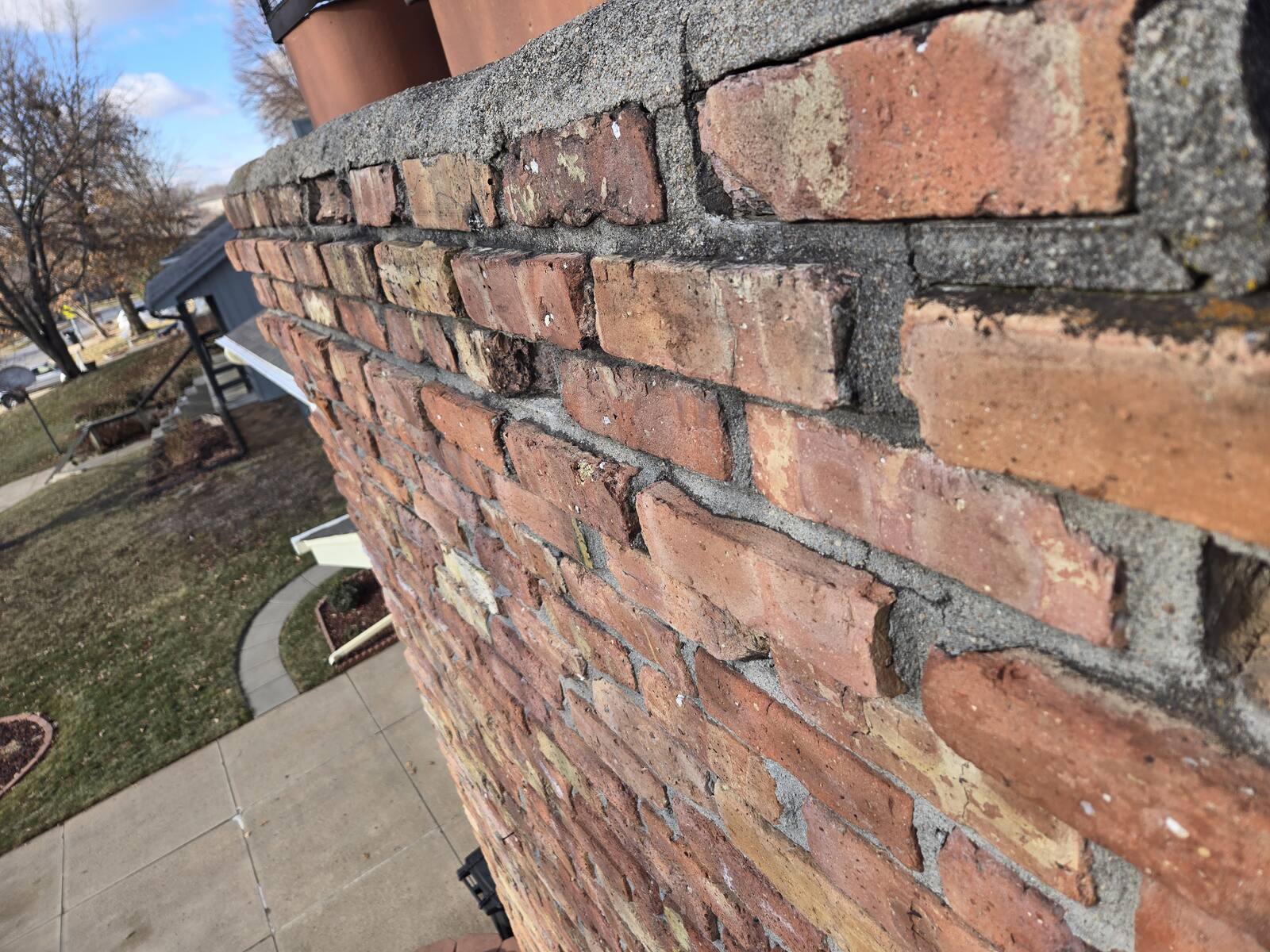
The same logic applies to your chimney and crown, which sit fully exposed on all sides and take the freeze and thaw worse than anything else on the house.
Six more places to look
Once you have walked the bottom courses, check these. Each one is a spot where water gets in.
- Around windows and doors. Look at the seam where stone meets trim. A gap there funnels water straight behind the veneer. Sealant that has hardened, cracked or pulled away from one side is doing nothing.
- Under sills and ledges. Any horizontal surface should shed water away from the wall. If a sill is flat, or slopes back toward the house, water is being delivered to the joint rather than dumped off it.
- Where veneer meets the roofline. Step flashing and kickout flashing are the usual weak point on a two story elevation. A missing kickout at the bottom of a roof to wall junction sends a roof's worth of runoff into one small area of wall.
- Behind and below downspouts. A downspout that dumps at the base of a veneered wall, or a gutter that overflows in a hard rain, will soak the same eighteen inches of stone every storm.
- At grade. Soil, mulch or a new patio that has been built up against the bottom of the veneer traps moisture. Stone should not be buried.
- Previous patches. A section that is a slightly different color, or where stones sit proud of the surrounding face, is usually a glue repair. Those almost always let go again, and they hide the real problem in the meantime.
Why a patch fails and a rebuild does not
The instinct when a stone falls is to stick it back on. Construction adhesive holds it for a season, sometimes two.
It fails for a simple reason. The stone did not come off because the adhesive between stone and mortar was weak. It came off because whatever was supposed to be holding the mortar to the wall was never there. Gluing the stone to a failed backing bonds it to something that is still failing, and it seals the face so water that gets in has one less way out.
Proper stone veneer repair means opening the section, checking what is actually behind it, and rebuilding the assembly in order: barrier, lath fastened into framing, scratch coat, then stone set into mortar. The wall ends up built the way it should have been the first time.
The other half of the job is making the repair disappear. Manufactured stone changes color with age and weather, so a section rebuilt with stone straight out of a box reads as a repair from the street. We color match into the surrounding field so the patch is not the first thing a visitor sees. We learned that method working alongside a manufacturer's field representative on a job in Bennington, and it is the difference between a repair and an obvious scar.
What to do about what you find
If you found nothing, note the date and check again next fall. Veneer that has held for fifteen years is not guaranteed to keep holding, but an annual look takes ten minutes.
If you found one loose stone or a short section of soft mortar, get it opened and looked at before winter. A small area is a small job.
If you found movement across a wide area, staining, or several patched spots, do not wait for spring. A wall in that condition is holding water going into the freeze, and every cycle makes the eventual repair bigger. We serve Gretna, Bennington, Elkhorn and the rest of the metro, and Omaha Masonry was named Best Concrete, Masonry and Brick Installation by the Omaha World-Herald.
Frequently Asked Questions
How do I know if my stone veneer is failing or just dirty?
Press on the bottom courses. Movement, a hollow sound or mortar that crumbles under a fingernail means failure. Surface dirt and algae wipe or wash off and leave sound stone behind. Staining that runs downward from a joint is usually water leaving the wall, not dirt landing on it.
Is fall really a better time to repair veneer than spring?
Yes, for one reason. A repair made before the freeze keeps water out of the assembly through the entire winter. Waiting until spring means the wall spends four months absorbing water and cycling through freeze and thaw, and the damaged area is usually larger by the time work begins.
Can I just glue the stones back on myself?
You can, and it will hold for a while. The stone came off because the backing behind it failed, so gluing it to that same backing does not address the cause and can trap moisture behind the face. It also makes the eventual proper repair harder, because the glued section has to come off first.
Will the repaired section match the rest of my wall?
It should. Manufactured stone weathers, so new stone out of a box rarely matches a wall that has been up for fifteen years. Color matching into the surrounding field is a separate step from setting the stone, and it is what keeps the repair from reading as a patch from the curb.
My house is only ten years old. Is it too new to have this problem?
No. Most of the veneer failures we see in the western suburbs are on homes built in the last fifteen to twenty five years. The issue is a missing layer in the original installation, not the age of the house, so it shows up on a timeline set by how fast water finds the gap.
If anything on this list turned up on your house, have it looked at before the ground freezes. Get in touch with Omaha Masonry or call 402-704-4894, and we will tell you honestly whether it is a small section or a wall.