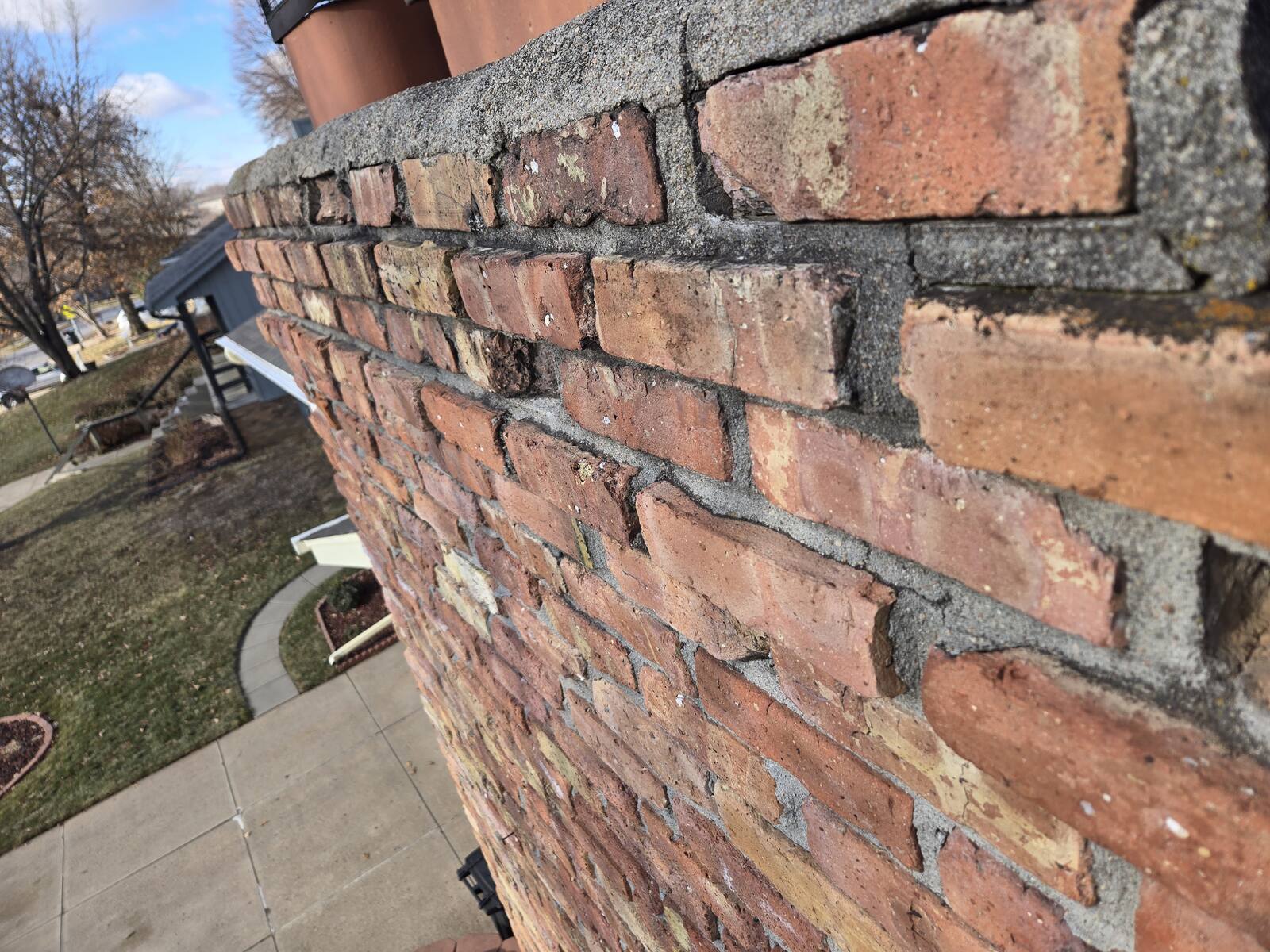
If the stone veneer on your Gretna home runs right down into the soil, mulch or driveway, it is worth a closer look. Manufactured stone needs a gap at the bottom and a weep screed so water trapped behind it can drain out. When the stone is buried or butted tight against concrete, that water has nowhere to go, and the bottom courses are usually where damage shows up first. The fix depends on what is behind the stone, which is why we look before we patch.
Omaha Masonry repairs manufactured stone veneer across the western suburbs, and Gretna, Elkhorn and Bennington are where we see this problem most. Many newer homes there were finished with stone that looks great on day one but was installed without the details that let it shed water. Here is what to look for and what it means.
How water gets behind stone veneer
Manufactured stone is not waterproof. Rain soaks into the stone and the mortar, and some of it reaches the wall behind. A properly built wall expects this. It has a water-resistant barrier, a drainage path, and an exit at the bottom so the water can leave.
The exit is the part that gets overlooked. Westlake Royal Building Products says in its installation guide for architects and builders that it is critical to install a weep screed at the transition point between the foundation and the framing. A weep screed is a metal strip at the base of the veneer that gives water a way out.
The clearance at the bottom matters
The same Westlake Royal guide notes that in most instances the weep screed provides a 4 inch clearance from grade or a 2 inch clearance from a paved surface. The Masonry Advisory Council gives the same figures in its article on code requirements of adhered veneer, saying adhered veneer should only be installed at least 2 inches above paved surfaces or at least 4 inches above grade.
That gap does two jobs. It keeps the bottom of the stone out of standing water, snow and wet soil, and it leaves the drainage path open so the wall can dry.
What we see on Gretna homes
When we inspect stone veneer on newer homes in Gretna and the other western suburbs, the bottom of the wall tells us a lot. The patterns that come up again and again:
- Stone running into the dirt or mulch. Landscaping added after the house was built often raises the soil line until it covers the bottom courses.
- Stone tight against a driveway, patio or stoop. When concrete is poured right up to the veneer, there is no gap for water to escape.
- No weep screed at all. On some homes the stone goes straight to the foundation with nothing at the base.
- Loose or missing stones at the bottom. This is often the first visible sign that water has been sitting behind the veneer.
We wrote more about how this failure develops in stone veneer water damage warning signs.
A quick check you can do yourself
You do not need tools to get a sense of whether your veneer has a clearance problem. Walk the outside of your home and look at the bottom edge of the stone.
- Look for a gap. Can you see space between the bottom of the stone and the ground or concrete below it?
- Look for a metal strip. A weep screed usually shows as a thin metal edge along the base of the stone.
- Check the soil line. Has mulch, rock or soil been piled up over the bottom of the stone?
- Check the bottom courses. Are any stones loose, cracked, stained or missing near the base?
- Check inside. Is there staining, musty smell or soft drywall on the inside of walls with stone outside?
If you answer no to the first two or yes to any of the last three, the wall deserves a professional look.
Why pulling back the mulch is not always enough
Sometimes the problem really is just landscaping. Lowering the soil or mulch and keeping it away from the stone can help. But if the veneer was installed without a drainage path or weep screed in the first place, clearing the soil only exposes the problem. Water still has no way out at the base.
Patching is the other common shortcut. Gluing loose stones back on, or caulking along the bottom, can make the wall look fine for a while. It does nothing for the water behind it, and in many cases it seals that water in. We covered why in our post on what a real stone veneer rebuild involves.
How we fix it
When the bottom of a veneer wall has failed, we remove the damaged section and look at what is behind it. If the backing was built without the layers it needs, we rebuild it so the wall can drain, set the proper clearance at the base, and reinstall stone that blends with the rest of the wall. Some of our approach comes from time spent with a manufacturer's field rep on a Bennington job, and we apply it to every veneer repair we take on.
Where concrete has been poured tight to the stone, we look at how the two meet and what it will take to restore a gap. Every house is different, and we explain what we find before any work starts. You can see more on our stone veneer repair page.
Timing your repair
Freeze and thaw cycles are hard on wet masonry. Water trapped at the bottom of a veneer wall freezes, expands and pushes stones loose, which is why damage often shows up in spring. If you spot the signs in late fall, have the wall looked at before winter so you know what you are dealing with. If you find them in spring, do not wait for another winter to make it worse.
Frequently Asked Questions
How much clearance should stone veneer have above the ground?
Industry guidance calls for about 4 inches of clearance above soil and about 2 inches above paved surfaces like driveways and patios. Westlake Royal and the Masonry Advisory Council both give those figures. The gap keeps the stone out of standing water and lets water behind the veneer drain out at the weep screed.
What is a weep screed on stone veneer?
A weep screed is a metal strip installed at the base of a stone veneer wall, where the foundation meets the framing. It gives water that gets behind the stone a way to drain out. Without one, moisture can collect at the bottom of the wall and damage the stone and the structure behind it.
Why are the bottom stones falling off my house?
The bottom courses take the most water. When veneer is installed without proper backing, a drainage path or clearance at the base, water collects there and freeze and thaw cycles push stones loose. Gluing them back on does not solve the water problem behind them, so the damage usually returns.
Can I just move the mulch away from my stone veneer?
It can help if landscaping is the only issue. If the veneer was installed without a weep screed or drainage layer, clearing the soil will not fix it, because water behind the stone still has no exit. A professional inspection tells you which situation you have before you spend money on the wrong fix.
Do you repair stone veneer in Gretna?
Yes. Gretna is one of the areas where we do the most stone veneer repair, along with Elkhorn and Bennington. See our Gretna service area page for more on the work we do there, or call 402-704-4894 to set up an inspection.
If the stone on your Gretna home runs into the ground or is coming loose at the bottom, we can take a look and tell you what is behind it. Omaha Masonry is an owner-led crew and an Omaha World-Herald Best Concrete, Masonry and Brick Installation winner. Call 402-704-4894 or contact us for an estimate.